
Roof Problems in West Michigan
Why Is My Roof Leaking?
A leaking roof is your house telling you something failed above the ceiling. In West Michigan it is almost never as simple as "a hole in the shingles."
This page explains what actually causes roof leaks, where they start, why they hide, what to watch for, and what to do right now.
Leaks Almost Never Start Where You See Them
Here's the most important thing to understand about a roof leak: the stain on your ceiling is almost never under the failure.
Water gets in under a shingle, at a flashing, at a nail hole. Then it runs. On top of the underlayment or on top of the roof deck, downhill, until it finds a seam or a nail hole or a gap it can drip through. Then it's inside the attic, running along the bottom of a rafter or a truss until it hits a spot where it lets go. If you're lucky, that spot is your ceiling and you see a stain. If you're not, it's inside a wall, and it can leak there for years. We've opened up walls that had been wet for decades.
And here's the second thing: even when it's headed for the ceiling, you won't see it for a while. Every time it leaks, the wood and the insulation soak up most of it. It takes a lot of water before any of it reaches the bottom of the drywall. Leaks go undetected for weeks, months, years, sometimes longer. Some are intermittent, and only show up in a wind-driven rain from a certain direction, or after a long soaking rain, and never any other time.
Finding the real source is a skill, and it's the one we're best at. We spent years as the company other roofers called when the leak wouldn't stop and nobody could figure out why. Chimneys caulked five times. Valleys that leaked through three contractors. That's where you learn how water actually moves through a roof.
What Causes Roof Leaks in West Michigan
Most leaks trace back to one of these. Several are made worse by our snow, ice, and lakeshore weather.
Ice Dams and Freeze-Thaw
The number one winter leak driver in West Michigan. Heat from the house warms the roof deck, snow melts from underneath, the water refreezes at the cold eave, and a ridge of ice backs water up under the shingles. It's an attic and ventilation problem showing up on the roof. More on our ice dam page.
Failed Flashing
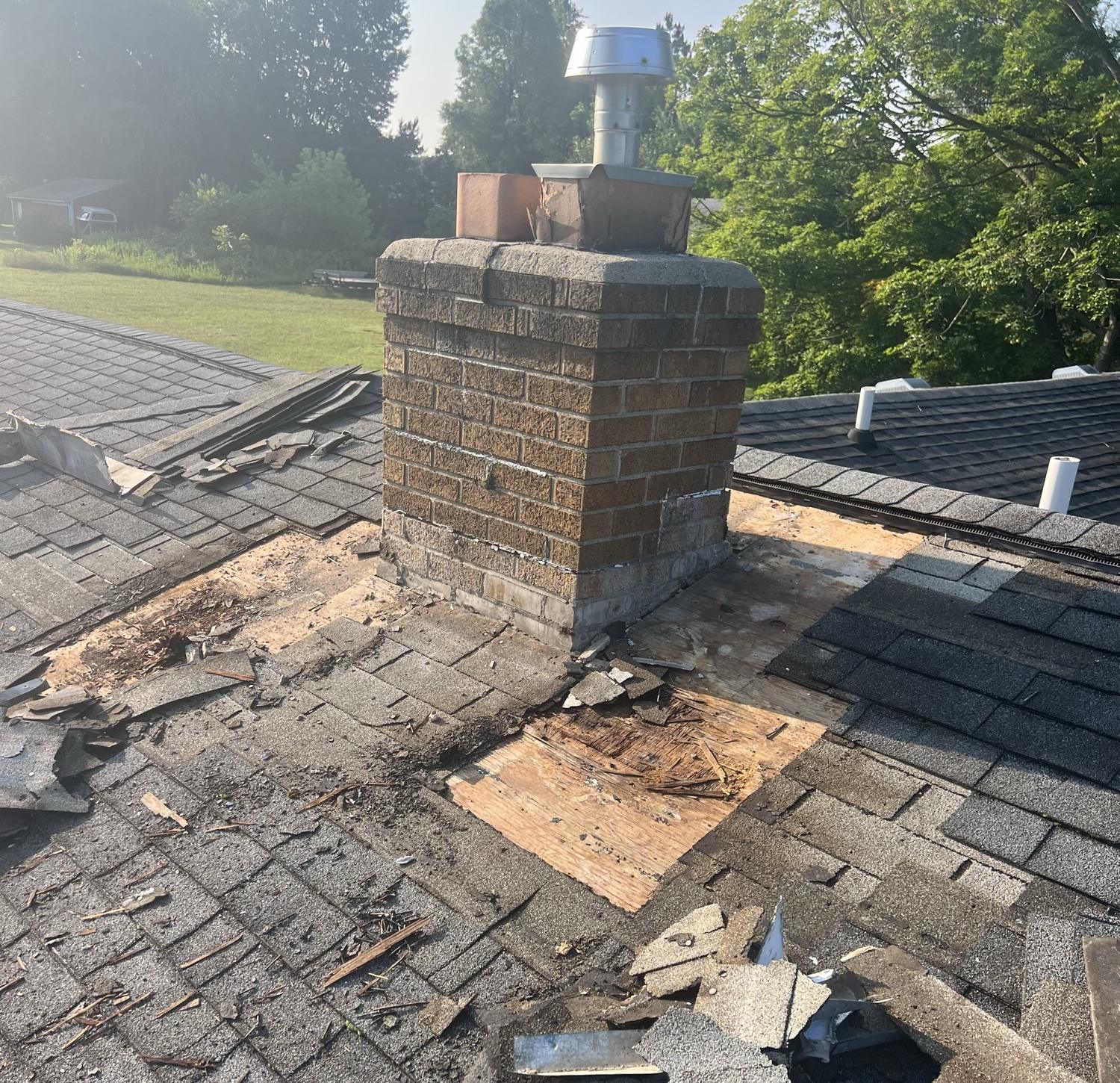
The formed metal that seals chimneys, skylights, valleys, and wall junctions is where most leaks begin. Reused step flashing, no kick-out at the bottom of a wall, counter flashing caulked instead of cut into the masonry, sealant doing metal's job. These are the failures we fix over and over. More on our flashing page.
Worn Pipe Boots and Vent Seals
The rubber collar around a plumbing vent, and the seals on roof vents, crack and shrink with UV and cold. They have a 10 to 15 year clock regardless of the shingle. Small penetration, common leak, easy to miss.
Missing or Wind-Lifted Shingles
Straight-line winds off the lake peel or crease shingles, especially on the exposed slopes. Once the shingle is gone or lifted, the underlayment and deck are taking every rain.
Installation Mistakes
A roof can leak in the middle of the field. A nail driven too close to a seam and rusted through. A shingle cracked on the top edge when the bundles were loaded, and nobody saw it. One shingle out of thousands seated a bit wrong on a long hot day. Each shingle takes five to ten seconds to install. It doesn't take much, and the leak might not show for a decade.
Clogged or Failing Gutters
Gutters full of leaves or ice can't drain. Water pools at the eave, wicks back under the roof edge, and rots the fascia and decking. This one shows up inside walls, not on ceilings.
Age and Granule Loss
Sun, snow load, and moisture wear asphalt out. After 15 to 20 years in West Michigan, brittle, curling shingles with heavy granule loss stop shedding water the way they were designed to. More on our granule loss page.
Where Roof Leaks Usually Start
Roofs don't fail evenly. Water finds the seams, penetrations, and edges, the places where the waterproof layer is interrupted. When we track a leak, these are the spots we check first:
- Around chimneys, skylights, and dormers where flashing seals the roof
- In valleys, where two slopes meet and channel the most water
- At plumbing vent pipe boots and attic vent penetrations
- Along the eaves and gutter line, especially after ice dams
- Where a lower roof meets a vertical wall
- Anywhere shingles are missing, cracked, or lifted
- Then, if none of those explain it, the field of the roof, one course at a time.
Two things make this harder than it sounds. First, a leak can have more than one source. The same spot on a ceiling can be fed by water coming in at two, three, or four different places on the roof, all running to the same low point. Fix one and the stain keeps growing, and now you think the repair failed. We've seen it plenty. It's why the first thing we do is not fix anything. We look at everything that could possibly be feeding that spot before we touch a shingle.
Second, flat roofs are their own problem. There's no slope to tell you which way the water ran, the membrane can carry water a long way from the entry point before it drops through a seam, and the entry might be a pinhole. Finding a flat roof leak takes a different set of eyes and a lot of them.
Notice that almost all of the spots above are flashing and penetration points. That's why a roof can leak while it looks perfect from the driveway.
Warning Signs Your Roof Is Leaking
Leaks often hide for weeks or months before they reach a ceiling. Catching them early saves thousands.
- Brown or yellow stains on ceilings or walls
- Peeling paint, bubbling drywall, or a sagging ceiling spot
- A musty, damp smell in the attic or upstairs rooms
- Dripping or active water during or after rain or snowmelt
- Dark streaks, mold, or mildew on attic rafters and sheathing
- Damp or matted attic insulation
- Icicles and thick ice along the roof edge in winter
- Shingle granules collecting in gutters or at downspouts
If you see even one, don't wait. A free inspection finds the true source and tells you how far the water has already traveled.
What a Roof Leak Can Do to Your Home
A leak is never just a stain. The longer water sits, the more it costs.
Rotted Decking and Framing
Trapped moisture rots the deck and the framing under it. Left long enough, a repair becomes a section rebuild. We've replaced entire roof sections and the rafters under them because a leak was ignored for ten winters.
Mold and Bad Air
Damp attic wood and wet insulation can grow mold within a day or two, and it spreads.
Ruined Insulation
Wet insulation clumps and loses its R-value, so it stops working, which drives up heating bills and makes ice dams worse next winter.
Electrical Hazards
Water tracking along framing can reach wiring, junction boxes, and fixtures. That's a shock and fire risk in the ceiling.
In Michigan's climate, moisture problems compound fast. A summer leak that seems minor freezes, expands, and reopens every winter, doing fresh damage every thaw.
What to Do Right Now
If your roof is leaking, a few quick steps protect the house while you line up the repair.
- Step 1
Contain the water
Move furniture and valuables clear, put a bucket under the drip, lay down towels. If the ceiling is bulging with trapped water, carefully poke a small hole at the low point with a screwdriver to drain it into a bucket. That relieves the pressure and keeps the ceiling from coming down.
- Step 2
Stay off the roof
A wet, icy, or snow-covered roof is dangerous, and you won't find the source from the outside anyway. Note where the water is showing inside and take a few photos.
- Step 3
Document everything
Photograph the stains, the dripping, and any damaged belongings. If the leak followed a storm, that documentation matters for a possible insurance claim.
- Step 4
Call us
The only way to stop a leak for good is to find and fix its true source. Call Stellar Roofing Company at (616) 840-1927. If it's active and getting worse, our emergency team can stabilize it today.
Ready to Stop the Leak for Good?
Understanding the cause is step one. Fixing it correctly is step two. Our roof leak repair service tracks the water back to its source, fixes the actual failure, and repairs the damage it left behind, so it stays fixed through the next Michigan storm.
See Our Roof Leak RepairNot Sure How Bad It Is?
Some leaks are a pipe boot and an hour on the roof. Some are the first warning of a roof at the end of its life. The answer comes from getting eyes on the roof and in the attic, not from guessing at the stain.
If you already know where the water is coming in, go to our roof leak repair page. If you'd rather have us find the source and assess the whole roof, book a free inspection. Either way you get a plain answer, repair or replace, and why.
Have an active leak right now? Call (616) 840-1927 or see emergency roof repair.
Roof Leak Questions Answered
Why is my roof leaking when it isn't even raining?
In West Michigan this usually means snowmelt and ice dams, not rain. Snow on a warm roof deck melts from underneath, runs down to the cold eave, refreezes, and backs water up under the shingles, so you get an active leak on a clear, cold day. Condensation from a poorly vented attic can also look like a leak. Both come back to the attic, and both are worth an inspection.
Where do most roof leaks actually start?
At penetrations and seams, not in the open field. Flashing around chimneys, skylights, and dormers, valleys, pipe boots, the eaves and gutter line, and where a lower roof meets a wall. Because water travels along the deck before it drips, the source is often several feet from the stain. And some leaks do start in the field, usually from a nail or a shingle that was wrong on day one and took years to show.
Is a small roof leak really an emergency?
Not always, but it never stays small. Trapped moisture rots decking and framing, ruins insulation, and can grow mold within a day or two. In our freeze-thaw climate a minor summer leak reopens every winter. Fixing it early is a fraction of the cost of the water damage that follows.
Can I fix a roof leak myself?
You can, and there's nothing wrong with trying. Here's what you're up against. Finding a leak can be simple or it can be extraordinarily hard, and so can fixing it. There is usually more than one way to stop the water. Which one is right comes down to how much you're willing to spend, how complex a solution you want, and how much tolerance you have for the leak coming back. What we bring is several decades of doing only this, on thousands of roofs and thousands of different situations, plus several hundred thousand dollars in specialized tools and equipment that let us do it fast, do it clean, and do it with as little wasted material as possible. That last part matters more than people expect. A professional can usually do a repair in about a fifth of the time it takes a homeowner, and a lot of that is the equipment. Take a chimney reflash. To do it right and do it in a few hours, we show up with a siding brake, grinders, blowers, circular and oscillating saws, impact drivers, nail guns, ladders, pitch hoppers, pry bars, hand benders, a rivet gun, an assortment of bits, sealant guns, and the right sealants for every material we'll touch. That kit runs about $10,000, and that's one type of repair. So it comes down to what your time is worth and whether you're going to buy or rent that equipment for a job you'll do once. Two things we'd ask, if you try it. Stay off a wet or icy roof. And don't reach for household caulk or roofing tar. Caulk doesn't belong on a roof and tar is meant to go between shingle layers, not on top of them. If you do try and it doesn't hold, call us. No judgment. Half the chimneys in our gallery had been patched by someone before us.
Does homeowners insurance cover a leaking roof?
It depends on the cause. Sudden storm damage, wind-lifted shingles or hail, is often covered. Leaks from age, wear, or deferred maintenance usually are not. Documenting the damage and getting a professional assessment before you file helps you and your carrier figure out which it is. Our inspectors are Haag Certified in wind and hail damage assessment, and we help West Michigan homeowners through storm claims regularly.
How do I know if I need a repair or a new roof?
That depends on the roof's age and how far the damage has spread. An isolated flashing or shingle failure on an otherwise sound roof is a repair, and most repairs carry a 10 to 15 year warranty. Widespread leaks, a roof past 20 years, or rotted decking usually point toward replacement. A free inspection gives you an answer for your specific roof instead of a guess.