
Roofing Materials • West Michigan
TPO Roofing: The West Michigan Guide
If you own a flat or low-slope building in Grand Rapids, Holland, or along the lakeshore, TPO is probably the membrane your roofer keeps bringing up, and for good reason.
This guide explains what TPO actually is, why its reflective surface saves energy, how long it lasts in Michigan's freeze-thaw climate, what installation involves, and how it honestly stacks up against EPDM and PVC.
What Is TPO Roofing?
TPO stands for thermoplastic polyolefin, a single-ply roofing membrane made from a blend of polypropylene and ethylene-propylene rubber. It arrives on the roof in large rolls, typically 10 to 12 feet wide, and covers the deck in a handful of continuous sheets rather than hundreds of small pieces.
What sets TPO apart is how the seams are joined. Instead of gluing or taping the overlaps, installers run a hot-air welder down every seam, melting the two sheets into one bonded membrane. Done correctly, the seam is as strong as the sheet itself. There's no adhesive to dry out, shrink, or peel over time, which is the number-one failure point on older flat roofs. Done incorrectly, a bad weld is a leak with a schedule, which is why the welder's hands matter as much as the roll.
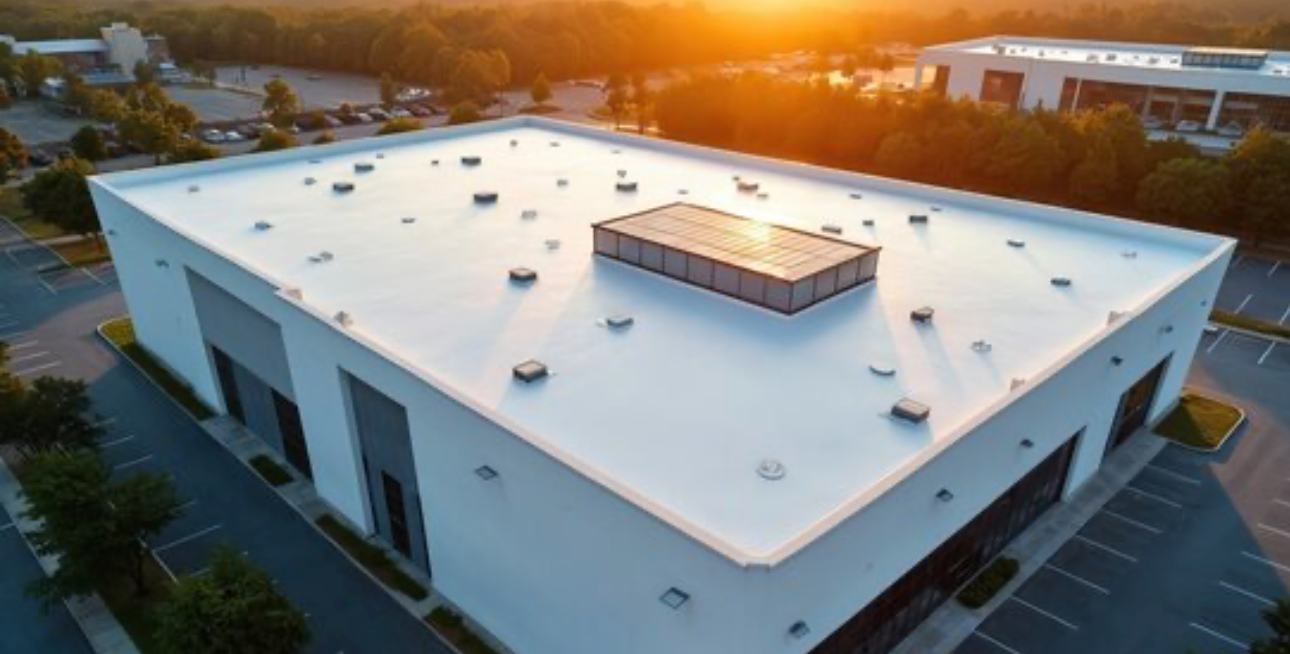
TPO is almost always white or light gray, and that bright surface isn't cosmetic: it reflects the sun instead of soaking it up, which is where the energy story begins. It has become the most widely installed commercial membrane in North America, and it shows up on low-slope residential sections too, though on a house we'll usually show you modified bitumen first, because its granulated cap sheet can be matched to your shingles so the flat section looks like part of the roof.
Why TPO Saves Energy
A black roof can hit 160°F on a July afternoon; a white TPO membrane in the same sun often runs 50 to 60 degrees cooler. That reflected heat is heat your air conditioning never has to fight, which is why TPO is called a cool roof.
Quality TPO is rated through the CRRC (Cool Roof Rating Council), the industry's independent reflectivity registry. For a West Michigan business, that can trim summer cooling costs and reduce strain on rooftop HVAC (heating, ventilation, and air conditioning) units.
The trade-off worth understanding: our winters are long, so the real energy win here comes from pairing that reflective surface with proper insulation. We spec rigid polyiso insulation to meet Michigan energy code, so the roof cuts summer heat gain without giving up winter R-value. The surface is half the answer. The insulation under it is the other half.
Flat & Low-Slope Roofs
TPO is a flat-roof membrane first and foremost. Here's where it makes the most sense across West Michigan.
Commercial Buildings
Retail plazas, offices, medical buildings, and warehouses around Grand Rapids almost always run flat or gently sloped roofs, the natural home for a TPO system.
Industrial and Warehouse
Large, wide-open roof planes cover fast and economically with wide TPO rolls, and the reflective surface keeps big interior spaces cooler.
Low-Slope Residential
Porch roofs, additions, and modern flat-roof homes need a membrane, not shingles. TPO handles the low pitches shingles can't, though on most homes we'll price modified bitumen alongside it, since its cap sheet matches the shingle roof it ties into.
Rooftop Equipment
Buildings loaded with HVAC units, vents, and curbs benefit from TPO's weldable flashings, which seal tight around every penetration.
Reroofs and Recovers
When an aging roof is failing but the deck is sound, a TPO recover over a recover board can avoid a full tear-off where code allows; Michigan Residential Code Section R908.3.1.1 caps a roof at two layers. We'll tell you honestly whether your roof qualifies or whether a recover would just seal in a problem.
Sun-Exposed Roofs
Full-sun exposure is where TPO's reflectivity earns its keep against black EPDM, all summer, every summer.
For the full flat-roof picture, see our flat roof systems page or explore our commercial roofing services.
TPO Pros & Cons
No roofing material is perfect. Here's the honest picture.
Advantages
- Highly reflective white surface lowers summer cooling bills
- Heat-welded seams create a fully bonded, watertight surface with no adhesive to fail
- Lightweight, adds little load to the existing deck
- Strong resistance to punctures, tears, and foot traffic in proper thicknesses
- Resists mold, algae, and dirt
- Class A fire rating available and CRRC rated
- Lower installed cost than PVC
- No plasticizers to leach out and turn the membrane brittle over time
Trade-Offs
- Formulations vary widely; cheap TPO from lesser manufacturers has a documented history of early weathering
- Thin 45-mil membranes age faster under UV and foot traffic
- Heat welding demands a trained crew; the temperature window is narrow, and a bad weld looks fine until it leaks
- Shorter field history than EPDM's six decades
- White surface shows dirt and needs periodic rinsing to stay reflective
- Chronic ponding still needs drainage designed, not just a tougher membrane
The takeaway: TPO quality varies more by manufacturer and thickness than almost any other membrane. Here's the education most companies skip: 60 mil is the minimum thickness the major manufacturers will write their 20-year no-dollar-limit warranties on, and what matters even more than the mil number is the thickness above the scrim, the reinforcing mesh inside the sheet, because that top layer is what takes the sun, the hail, and the boots. An 80-mil sheet with a thin top ply can underperform a well-built 60. When you compare TPO bids, ask both numbers. If the bidder can't answer, that's your answer.
How Long Does TPO Last?
A properly installed, quality TPO roof lasts 20 to 30 years in West Michigan. Membrane thickness sets the floor: 45 mil is the economy option, while 60 and 80 mil carry longer manufacturer warranties and hold up far better to hail, foot traffic, and years of UV.
Our freeze-thaw cycles are the real test. Water that sits on a flat roof, freezes overnight, and thaws the next afternoon will find any weak seam or flashing, and it will do it a few dozen times a winter. Because TPO seams are welded rather than glued, they resist that cycle better than taped systems, provided the welding was done right. Modern TPO formulations are also substantially better than the first-generation material from the 1990s that gave the product an early bad reputation; membrane chemistry is no longer the weak point on a name-brand roof. The installer is.
You add years with simple upkeep: drains kept clear, the reflective surface rinsed, and seams and flashings inspected each spring after winter has done its work. A roof maintenance plan and an annual inspection are the cheapest protection the investment can have.
TPO vs. EPDM vs. PVC
The three membranes we're asked about most. Honest answer first: we install TPO and EPDM. We don't install PVC (polyvinyl chloride), and we'd rather tell you that than pretend. PVC is in the table because you'll see it in other bids, and because for one specific kind of roof, it's genuinely the right product.
| Membrane | Surface | Seams | Lifespan | Best For |
|---|---|---|---|---|
| TPO (thermoplastic polyolefin) | White, reflective | Heat-welded | 20 to 30 years | Energy savings on sun-exposed flat and low-slope commercial roofs |
| EPDM (rubber) | Black, white available | Taped and glued | 25 to 30+ years | The proven cold-climate workhorse with the simplest repairs and lowest cost |
| PVC | White, reflective | Heat-welded | 20 to 30 years | Restaurants and roofs exposed to grease, oils, or chemicals. We don't install it, and if your roof genuinely needs it, we'll tell you so |
Short version: choose TPO for reflectivity and welded seams on a sun-baked roof, EPDM for the longest track record at the lowest cost, and if you run a restaurant with grease-laden exhaust hitting the roof, PVC is the right chemistry, and we'll say exactly that rather than sell you the wrong membrane. Mile wide and an inch deep isn't how we operate; we stay in our lane and tell you when your roof is outside it. Compare all three against modified bitumen on our flat roof systems page.
How TPO Is Installed
A TPO roof is only as good as its installation. Here's how one gets built from the deck up.
- Step 1
Tear-Off or Recover
We remove the failed membrane down to the deck, or, when the deck is sound and code allows, install a recover board over the existing roof to save the tear-off and disposal. The moisture scan decides which; covering wet insulation just buries the problem.
- Step 2
Insulation and Cover Board
Rigid polyiso insulation goes down to the required R-value with a cover board on top, specced to Michigan energy code so the roof performs in January, not just July.
- Step 3
Membrane Attachment
The TPO sheet is mechanically fastened or fully adhered depending on the building, wind exposure, and lakeshore wind loads.
- Step 4
Heat-Welded Seams
Overlaps are fused with a hot-air welder into a single monolithic membrane. The seam becomes as strong as the sheet, with no adhesive to fail, and the welds get probe-tested, because a weld that merely looks good isn't a standard.
- Step 5
Flashings and Details
Curbs, drains, pipes, and parapets are wrapped in matching TPO flashing and welded tight. The details are where flat roofs leak, so the details are where the time goes.
TPO Roofing Cost in West Michigan
Installed TPO typically runs roughly $6 to $11 per square foot in our market, including insulation, membrane, and welded flashings, with thickness, attachment method, and tear-off versus recover setting where you land in the range. Figures below are planning estimates, not quotes.
| Building Type | Roof Area | Estimated Range |
|---|---|---|
| Small commercial or garage | 1,500 to 3,000 sq ft | $9,000 to $33,000 |
| Mid-size retail or office | 5,000 to 10,000 sq ft | $30,000 to $110,000 |
| Warehouse or industrial | 15,000 to 30,000 sq ft | $90,000 to $330,000+ |
| Low-slope residential porch or addition | 300 to 800 sq ft | Priced on inspection; small flat sections carry setup costs that per-square-foot math hides |
Your real number depends on membrane thickness, insulation R-value, tear-off versus recover, roof access, and the count of penetrations; a roof loaded with HVAC curbs and drains costs more to detail than a clean open plane, and larger roofs cost less per square foot because setup spreads across more area. We confirm every figure with an on-site measurement, and on commercial projects we can pair the quote with commercial lending options.
Is TPO the Right Choice for Your Roof?
TPO is an excellent fit for most West Michigan flat and low-slope roofs, but not every one. Our job is to look at your building, how the roof is used, and your budget, then recommend the membrane that actually serves you. Sometimes that's TPO. Sometimes it's EPDM, modified bitumen, or a silicone coating on the roof you already own. We install all of those, which is exactly why the recommendation is about your roof, not our inventory.
We'll walk the roof, check the deck and existing insulation, document the condition, and explain your options in plain language before any work begins.
TPO usually makes the most sense when:
- You have a flat or low-slope roof
- Summer cooling costs are a concern
- The roof bakes in full sun
- You want welded, watertight seams
- The existing deck is sound
- You want the strongest price-to-performance balance in a reflective membrane
Ready for a real number instead of a range? Schedule your free roof inspection or call or text (616) 840-1927.
Schedule Your Free Roof InspectionExplore Flat-Roof Options & Services
Flat Roof Systems
Compare TPO, EPDM, and modified bitumen side by side.
Learn MoreEPDM Roofing
The proven rubber membrane, and when it beats TPO.
Learn MoreCommercial Roofing
Our full commercial and low-slope roofing service.
Learn MoreRoof Maintenance
Preventative programs that extend membrane life.
Learn MoreTPO Roofing Questions
How long does a TPO roof last in Michigan?
A quality TPO roof properly installed lasts 20 to 30 years here. Thickness sets the floor, 60 mil is the standard the major manufacturers require for their 20-year no-dollar-limit warranties, and the welding sets the ceiling, because our freeze-thaw winters find every weak seam. Modern name-brand TPO formulations have largely solved the early-weathering problems of the 1990s material; installation quality is now the difference between 20 years and 30.
Is TPO better than EPDM?
Neither is universally better. TPO wins on sun-exposed roofs where its white reflective surface and welded seams cut cooling costs and seal out ponding cycles. EPDM wins on cost, cold-weather flexibility, six decades of track record, and the simplest repairs in roofing. We install both, so the recommendation you get is based on your building's sun exposure, budget, and use, not on which membrane we happen to sell.
What does TPO cost in West Michigan?
Roughly $6 to $11 per square foot installed, including insulation and welded flashings. Membrane thickness, attachment method, tear-off versus recover, and the number of penetrations set where you land, and larger roofs run cheaper per square foot. Small residential flat sections are priced on inspection because setup costs distort per-foot math at that size. We confirm every number on site, and commercial lending is available on commercial projects.
What mil thickness TPO should I get?
Two numbers matter. First, 60 mil is the minimum every major manufacturer requires to write a 20-year no-dollar-limit warranty; 45 mil is the economy sheet for low-traffic roofs with easy access. Second, and this is the one nobody tells you, the thickness above the scrim, the reinforcing mesh inside the sheet, matters more than the total, because that top layer is what takes the UV, hail, and foot traffic. Ask both numbers on every bid. A roof with regular HVAC service or heavy traffic earns 60 to 80 mil; a lightly used roof doesn't need to pay for 80.
Can TPO be installed over my existing roof?
Sometimes. When the deck is sound, the insulation is dry, and the roof is within Michigan's two-layer cap under MRC Section R908.3.1.1, a recover board and new TPO can skip the tear-off and its disposal costs. The deciding factor is moisture: we scan before recommending a recover, because covering wet insulation doesn't fix a roof, it hides one. If the scan says tear off, we'll show you why.
Why don't you install PVC?
Because doing everything is how companies do nothing well, and PVC is a specialty chemistry with its own welding behavior, its own failure modes, and one killer application: roofs exposed to grease, oils, and chemicals, mostly restaurants. We're a mile deep in TPO, EPDM, modified bitumen, and coatings instead. If our inspection says your roof genuinely needs PVC, we'll tell you that to your face and point you toward it, because recommending the right membrane matters more to us than installing the wrong one.