
Roofing Materials • West Michigan
EPDM Rubber Roofing: The West Michigan Guide
EPDM, ethylene propylene diene monomer, is the black rubber membrane you've seen on flat commercial roofs for decades. It's durable, cost-effective, and it stands up remarkably well to Michigan winters.
This guide explains how EPDM works, how long it lasts, what it costs to install around Grand Rapids, and how it compares to TPO, so you can choose the right flat-roof system with confidence.
What Is EPDM Roofing?
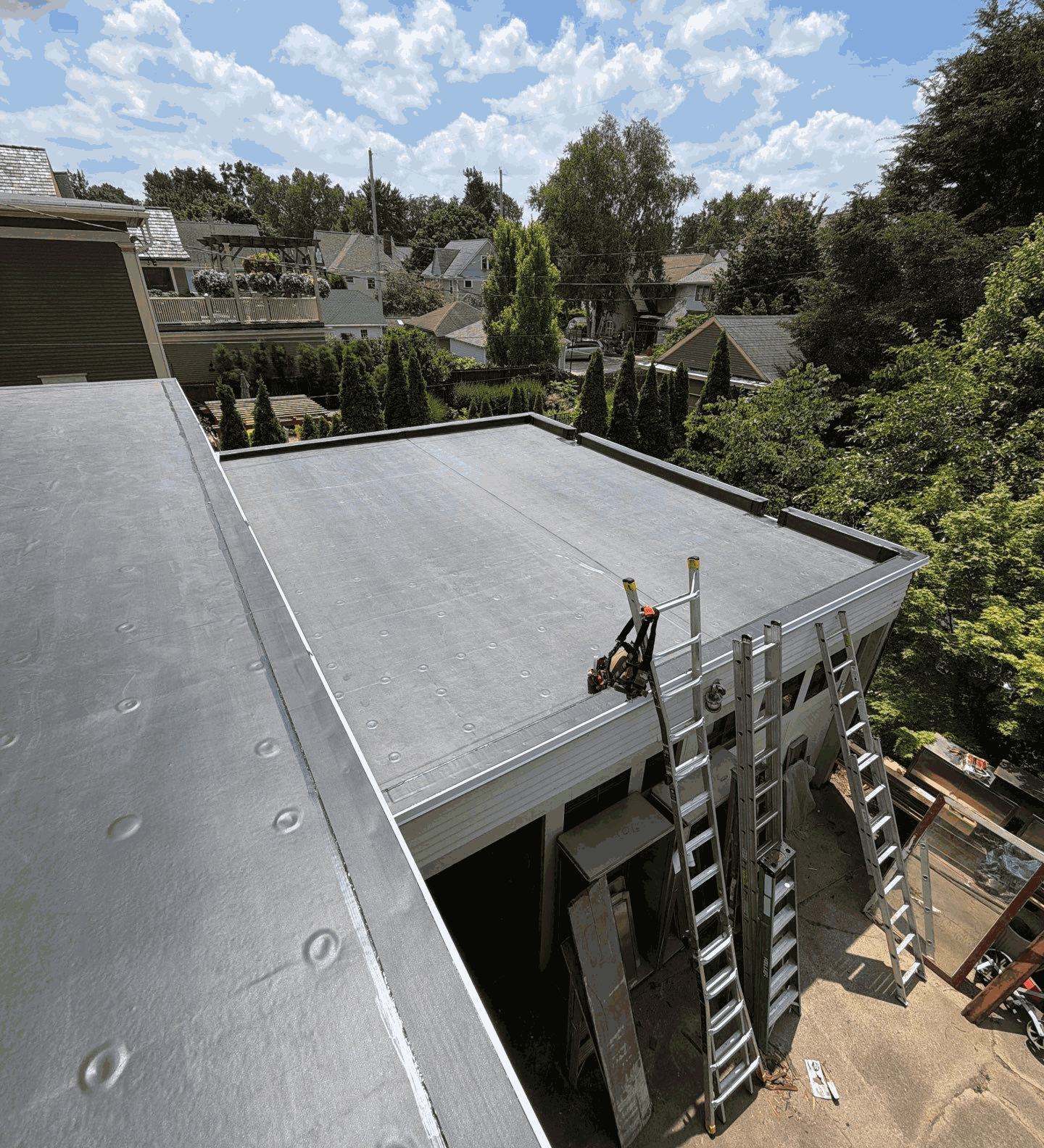
EPDM is a synthetic rubber membrane engineered for low-slope and flat roofs. It arrives in wide rolls, which are rolled out over the roof deck and insulation, then either glued down (fully adhered), mechanically fastened, or held in place with stone ballast. Because the sheets are so large, a typical West Michigan warehouse or office roof can be covered with very few seams, and every seam is a potential leak point, so fewer is better.
What makes EPDM the workhorse of the flat-roof world is longevity paired with price. It's been installed on North American commercial buildings since the 1960s, so its performance is exceptionally well documented. In a climate like ours, where a roof can swing from 5°F under lake-effect snow load in January to 90°F in July, that proven durability matters. EPDM stays flexible in bitter cold instead of turning brittle, which is exactly why it remains a go-to for Grand Rapids, Holland, Wyoming, and Kentwood commercial roofs.
On homes, the picture is a little different, and we'll tell you straight: for the flat sections of a house, porches, dormers, additions, our first choice is usually modified bitumen, because its granulated cap sheet can be matched to your shingles so the flat section looks like part of the roof instead of a patch on it. EPDM is the budget-friendly alternative there, and we install both. On commercial buildings and large low-slope areas, EPDM competes on its own merits.
How Long Does EPDM Last in Michigan?
A properly installed and maintained EPDM roof commonly delivers 25 to 30 years of service, and many outlast that when they're inspected and cared for.
25 to 30+
Years of service life
A quality fully adhered EPDM roof routinely reaches three decades in West Michigan when the seams are kept sound.
Stays flexible in deep cold
EPDM remains pliable in the coldest temperatures Michigan sees, so it resists the winter cracking that ends other membranes early.
60 mil
Common membrane thickness
Thicker 60 or 90 mil sheets add puncture and hail resistance, worth it under our storm-prone summers.
The single biggest factor in reaching the high end of that range is maintenance. Seams, flashings, and rooftop penetrations are where leaks start, and a simple annual maintenance visit catches small issues before they soak the insulation and deck below. That's true of every flat roof ever built, and it's why we put every commercial roof we touch on a maintenance schedule.
EPDM Pros & Cons
No roofing material is perfect for every building. Here's the straight story.
Advantages
- One of the lowest installed costs of any flat-roof membrane
- Proven 25 to 30+ year track record in Michigan's freeze-thaw climate
- Stays flexible in sub-zero cold, so it resists winter cracking
- Few seams on large roofs means fewer places to leak
- Simple, fast repairs: a rubber-to-rubber patch is quick and inexpensive
- Lightweight, rarely needs added structural support
Trade-Offs
- Standard black membrane absorbs summer heat (white membrane or a reflective coating solves it)
- Seams are glued or taped, not heat-welded like TPO
- Punctures from dropped tools or foot traffic need prompt patching
- Less reflectivity than a TPO or coated system
- Aging adhesive seams need maintenance to stay sound over the decades
Most of those trade-offs are manageable. Black EPDM's summer heat gain is solved with a white membrane option or a reflective silicone coating, and glued seams have decades of proven performance behind them when they're installed by an experienced crew and maintained. The membrane rarely fails on its own; roofs fail at the details, which is why who installs it matters more than the roll.
TPO vs. EPDM: Which Flat Roof Is Right?
EPDM and TPO are the two most common single-ply membranes we install in West Michigan. Neither is universally better. The right choice depends on your building.
| Feature | EPDM (Rubber) | TPO |
|---|---|---|
| Membrane color | Black (white available) | Reflective white |
| Seam method | Adhesive and seam tape | Hot-air heat weld |
| Typical lifespan | 25 to 30+ years | 20 to 30 years |
| Cold-weather flexibility | Excellent | Good |
| Summer heat reflection | Lower unless coated | High |
| Installed cost | Lower | Moderate |
| Repair ease | Very easy, patch and go | Requires welding gear |
| Best fit | Low-slope, shaded, budget-focused | Sun-exposed, cooling-cost focused |
Choose EPDM when up-front budget is a priority, when the roof is shaded or low-slope, and when you value a decades-long track record with the simplest possible repairs. It's a particularly strong pick where cold-weather performance outweighs summer cooling savings.
Choose TPO when the roof bakes in full sun all summer and you want the bright white membrane reflecting heat off your cooling bill, or when you prefer heat-welded seams. Compare both systems in depth on our flat roof systems page.
EPDM Roofing Cost in West Michigan
EPDM is one of the most cost-effective flat-roof membranes you can buy. Here are realistic planning ranges for the Grand Rapids area, not quotes.
EPDM, fully adhered
Roughly $5.50 to $9.50 per square foot installed
Lifespan: 25 to 30+ years. Membrane glued directly to the insulation. Clean look, and the most common choice on West Michigan commercial reroofs.
EPDM, ballasted
Roughly $4.50 to $7.50 per square foot installed
Lifespan: 25 to 30+ years. Loose-laid and weighted with stone. Lowest cost, but heavier on the structure and harder to inspect for leaks.
TPO, heat-welded
Roughly $6 to $11 per square foot installed
Lifespan: 20 to 30 years. White reflective membrane with welded seams. Higher up-front cost, strong summer energy savings.
Installed pricing depends on roof size, insulation thickness, deck condition, the number of penetrations (vents, HVAC curbs, drains), and whether the old roof needs a tear-off. Larger roofs cost less per square foot because setup and labor spread across more area. We confirm your exact number after an on-site inspection, and on commercial projects we can pair the quote with commercial lending options.
Is EPDM Right for Your Building?
EPDM is the right call for a wide range of low-slope roofs across West Michigan. It makes the most sense for:
- Flat and low-slope commercial buildings across Grand Rapids and Kentwood
- Warehouses, retail strips, and office roofs with large uninterrupted spans
- Church, school, and municipal roofs where budget and longevity both matter
- Reroofs over an aging built-up (tar-and-gravel) or existing rubber roof
- Flat sections on homes where budget leads, though we'll show you modified bitumen first
Not sure whether EPDM, TPO, modified bitumen, or a silicone coating fits your roof best? That's exactly what our free inspection is for. We'll assess the deck, drainage, and sun exposure and recommend the system that gives you the best value over its full life, not the one we happen to have on the truck.
Schedule Your Free Roof InspectionExplore Flat-Roof Options & Services
Commercial Roofing
Our full commercial and low-slope roofing service.
Learn MoreFlat Roof Systems
Compare EPDM, TPO, and modified bitumen side by side.
Learn MoreRoof Replacement
Full tear-off and reroof for homes and businesses.
Learn MoreRoof Maintenance
Preventative programs that extend membrane life.
Learn MoreEPDM Roofing Questions
How long does an EPDM roof last in Michigan?
A properly installed and maintained EPDM roof commonly lasts 25 to 30 years in West Michigan, and many exceed that. EPDM stays flexible in extreme cold, so it resists the winter cracking that shortens other membranes. The biggest factor in reaching the high end is keeping the seams and flashings sound with an annual maintenance visit.
Is EPDM or TPO better for a flat roof?
Neither is universally better; it depends on the building. EPDM is lower cost, extremely durable in cold weather, and has the simplest repairs, making it ideal for shaded, low-slope, or budget-focused roofs. TPO is a reflective white membrane with heat-welded seams that cuts summer cooling costs on sun-exposed roofs. We help you compare both after inspecting your roof.
How much does EPDM roofing cost in West Michigan?
In the Grand Rapids area, fully adhered EPDM typically runs roughly $5.50 to $9.50 per square foot installed, and ballasted EPDM roughly $4.50 to $7.50. Final pricing depends on roof size, insulation, deck condition, the number of penetrations, and whether the old roof needs a tear-off. Larger roofs cost less per square foot. We confirm your number with a free on-site inspection.
Can EPDM be installed on a house, not just commercial buildings?
Yes, and it ties in cleanly to adjacent shingle roofing. That said, on the flat sections of a house, porches, dormers, additions, our first recommendation is usually modified bitumen, because its granulated cap sheet can be matched to your shingles so the flat section looks like part of the roof. EPDM is the budget-friendly alternative, and we'll show you both and price both.
Does black EPDM make a building hotter in summer?
Standard black EPDM absorbs more solar heat than a white membrane. If summer cooling cost is a concern, you can choose a white EPDM option or apply a reflective silicone coating over the black membrane, and we adhesion-test every substrate before coating. For roofs that bake in full sun all day, reflective TPO may be the better fit. We'll walk you through the options.
Can a leaking EPDM roof be repaired instead of replaced?
Usually, yes. One of EPDM's biggest advantages is how simple and inexpensive repairs are: a rubber-to-rubber patch over a puncture or a resealed seam is quick and effective. As long as the membrane and insulation are still in good shape, targeted repairs add years of service before a replacement is needed. Our gallery has a residential EPDM flat roof that proves the other side too: when a cheap contractor's rubber roof fails in two years, we tear it off and build it right.